Showing posts with label Curaçao. Show all posts

Tuesday, October 3, 2017

Julieta: Film Reviews from the Curaçao Film Festival #ciffr

Julieta, Pedro Almodóvar, 2016
CIFFR: Thurs Apr 6, 2017

Almodóvar is a little like Quentin Tarantino for me. No, not in style. I mean in the sense that I either adore or abhor their films. No in-between, no middle grounds... Tarantino and Almodóvar, to me, are either geniuses or morons, depending on what film we're talking about. (To be fair, I do like many more Almodóvar films than I do Tarantino ones.)

Sunday, August 20, 2017

The Other Side of Hope: Film Reviews from the Curaçao Film Festival #ciffr

The Other Side of Hope, a film from Finnish director Aki Kaurismäki about a Syrian immigrant in Finland and officially labeled a comedy (more on that below), was the opening film for the Curaçao film festival on Wednesday April 5th. When we were making our selections for the festival, I marked this one as a must-see: immigration, especially from Syria, has taken a prominent role in news and debates worldwide, and after my dushi spewed a few anti-immigration sentiments (on which I swooped down like a rapacious bird of prey, no mercy, no quarter, until I saw a dawning light of reason in his eyes), I thought a story such as this one might help elucidate some of the finer points in the refugee-crisis dispute.


Sunday, July 2, 2017

The #WATWB June Edition: Celebrating Diversity

Love rules!!!!

June 30th, was a landmark day for Europe. The German parliament voted to legalize same-sex marriage after an emotional, if brief, debate that resulted in a 393-vs.-226 vote in favor. After three decades of the struggle for equality, and especially given the present rise of conservative policies worldwide, this victory for equality comes as a beautiful, and much-needed, source of hope for a more inclusive climate everywhere. As one member of the German parliament put it during the opening debate, with the legalization of gay marriage "many will receive something, but nobody will have something taken away.” (Thomas Oppermann, parliamentary leader of the Social Democrats)

June 30th also brought cause for celebration on a more personal, but still related, note: my dushi celebrated 20 years since coming to live in Curaçao. He never imagined, back then, that he'd stay on this rock so long; like most financial services employees, he came to the island with a three-year contract, and he hadn't given much thought to what he'd do after. But Curaçao won him over rather quickly. People who had arrived around the same time he did began leaving: to other financial centers, back to Holland, or changing career tacks, marrying and moving away... And, year after year, farewell party after farewell party, Cor stayed. He was offered a couple of good opportunities elsewhere, but—for one reason or another—he ended up turning them down. (Which was a good thing; otherwise we might never have met.)

Curaçao does that to some people. Not to everyone, maybe not even to the majority of expats and immigrants who come here. Lots of people have a hard time with the island; many never adapt, several can't wait for their contract to be up so they can leave. The smallness, the endemic limitations, the heat, you name it: there are plenty of reasons to dislike living here. But, for some of us, the cons can't hold a candle to the pros.


The pros might seem obvious; we're a Caribbean island, after all. Sun, sea, flip-flops and shorts, seafood and ice-cold beer, feet in the sand, cocktails with umbrellas in them. Not to undervalue these, but... well, pretty much any seaside destination offers variations thereof. No, what makes Curaçao special—truly special—has to do with diversity. Over 50 nationalities live here; all religions are present, all cultures, all colors. Just imagine the variety of delicious cuisine we have! And food becomes a metaphor for all sorts of wonderful things. No, Curaçao is no melting pot; that would imply a homogeneity of flavor and texture that would become antithesis to diversity. Food, however, says it best: flavors meet in combinations that build on each other, that borrow from each other not just to improve but to broaden the experience. Our experience. Our selves.

Today, July 2nd, the island is celebrating Dia di Bandera (Flag Day), and our new Prime Minister—a man who stands for diversity and inclusivity—posted this message on his Facebook page:


TRANSLATION FROM PAPIAMENTU (mine): "Our island is very diverse. People from different origins, cultures, and religions, together forming a nation which is unique. Which lives from union, united in our diversity. We are proud to live together with each other, here in our dushi Curaçao. Let's keep caring for and supporting each other, so that we can all continue prospering, together under one flag. Happy Flag Day."

And this year it's an especially happy celebration for Kòrsou: our soccer team won the Caribbean Cup last week—for the first time! EVER! It was the first time they even made it to the final. That footage in Mr. Prime Minister's video above showing the crowds waving little flags are from the welcome the team got at the airport Tuesday evening. Yes, we're very, very proud of them. 

Celebrations at Brionplein last Tuesday, when the Curaçao soccer team returned to the island after winning the Caribbean Cup — for the first time in history!

But I digress. The point I'm trying to make here is about diversity, and about how sharing space—a city, a nation, a life—with others, with very different others, is no impossible dream. Curaçao is living proof of that. This island is far from perfect—same-sex marriage, for instance, is still not legal here—and there's certainly room for improvement on all sorts of areas (corruption is a big, big problem; illegal immigration is, too, and there's still a lot of unresolved conflict with Holland), but the thing that makes Curaçao different from other diverse places is the attitude. In Curaçao, difference is normal. No one expects anyone else to be the same as they are. Diversity in background and religion is a given; people take it in stride, take it even for granted: everyone is different. It's not just how it is, but how it should be. And people here do, mostly, get the enormous benefits of a diverse society. 

I have hope that the world will, one day, not too far away, take the hint and follow the example.


Curaçao's national anthem (original Papiamentu, with the English translation—mine, don't quote me—in italics):

Lantá nos bos ban kanta
     Raise our voices to sing
grandesa di Kòrsou;

     the greatness of Curaçao
Kòrsou, isla chikitu,

     Curaçao, small island,
baranka den laman!

     cliffs at arm's reach
Kòrsou, nos ta stima bo

      Curaçao, we love you
ariba tur nashon.

      above all nations.
Bo gloria nos ta kanta

      Your glory we sing
di henter nos kurason.

      with our whole heart.
Nos pueblo tin su lucha,

      Our people have our struggles,
ma semper nos tin fé

      but always we have faith
di logra den tur tempu

      we'll achieve every time
viktoria ku trabou!

      victory with our toils!
Ban duna di nos parti

     Let's do our part
p'e isla prosperá.

     so the island may prosper.
Laga nos uni forsa
     Let us join forces
p'asina triunfá.

     in order to triumph.
Nos patria nos ta demostrá

     To our homeland we show
Honor i lealtat,

     honor and loyalry,
meskos na e bandera

     same as we do to our flag
union di nos nashon.

     union of our nation.
Nos bida lo ta poko

      Our life is a small thing
pa duna nos pais,

     to give to our country,
luchando uní pa libertat,

     fighting together for freedom,
amor i komprenshon.

     love, and understanding.
I ora nos ta leu fo'i kas

     And when we are far from home
nos tur ta rekordá

     we all remember
Kòrsou, su solo i playanan,

     Curaçao, its sun and beaches,
orguyo di nos tur.

     pride of us all.
Laga nos gloria Kreador

     Let us give glory to the Creator
tur tempu i sin fin,

     always and endlessly,
k'El a hasi nos digno

     that He has made us worthy
DI TA YU DI KÒRSOU!

     OF BEING CHILDREN OF CURAÇAO!


This post is part of the We Are The World monthly blog hop, an effort to change the focus of our ill-riddled world to hope and positivity, hosted by the most excellent Damyanti Biswas, of Daily Write fame, and co-hosted this month by Belinda Witzenhausen,  Lynn HallbrooksMichelle WallaceSylvia McGrath, Sylvia Stein


Monday, April 17, 2017

I am shameless... (And I apologize.)

So much for my new year's resolution to not let more than two weeks go by without posting... It's going on 3 months since my last post here, and more than that on the dog blog; it's a wonder I even remember how to. Shame on me.


Much has happened to blog about, and plenty of times I began composing drafts of posts... I just never got around to finishing them before things changed. Again. I got a job, which upended my 'carefully balanced' schedule of dog walks and writing and (at least the intention of) blogging. I've since quit said job (yeah, short-lived experiment; one learns more from mistakes than from success). Two of the four puppies we took in as fosters back in December are still not adopted, which means they're still here, and as part of our effort to make them more adoptable I've begun taking them to training (well, one of them, since that's all I can afford time- and money-wise). I'm still not done with the dog book, but over the last two weeks I made some serious progress. I hope to have that done and delivered to the publisher for another round of edits before the month is out.

The dog book cover, as designed by Everytime Press

Oh, and we had the film festival here in Curaçao two weeks ago, April 5th to 9th. Forty-seven absolutely extraordinary films (well, except one). Impossible to see them all, obviously, but we did manage, with careful logistics planning that included Cor taking off two whole days from work (and one extra one after the festival, just to rest up), to see fifteen of them. Sixteen, if you count the preview film, Jackie, which screened one week before the festival began (and again during the festival, but seeing it beforehand allowed us to fit in one more film over that busy weekend).

Our film-fest booty, courtesy of Cor (who, unlike me, remembers to take photos of these things for posterity):
tickets grouped and stapled by day, from Wed Apr 5th through Sunday Apr 9th.

And I desperately want to share those fifteen (fine, sixteen) films we saw. They were thought-provoking and gorgeous: their narrative styles, the cinematography, the diversity of stories and points of view, their timeliness and value in view of current events. So, as of this week, I'll start posting a review every few days here. No, I won't make the mistake of committing to a certain day of the week or even a fixed (-ish) schedule; we all know how well that's worked out for me in the past. But I do want to share them, for you film-lovers out there, of course, but also for me, as a sort of journal record of the impact these films had on me.

So... See you soon!

Thursday, January 14, 2016

Meanwhile, on the Miracle front...

The Chit Chat Café at Mensing's Caminada, Curaçao's largest
bookstore. The café has graciously agreed to host us for
the launch.
The Miracle of Small Things has come home. Thanks to the wonderful people at Mensing's Caminada bookstore, the book is now for sale here in Curaçao, the island that gave it life. The official launch is planned for Saturday Feb. 13th, but we decided that—due to the long wait—it was a good idea to put a few copies up for sale pre-launch.

Why the long wait? Why not do the launch earlier—now, for instance? Or—as we'd originally planned—before Christmas and the big shopping season? Yes, that would've made sense. But living on an island that no one (including international postal services) can find on a map has its drawbacks.

Thursday, January 7, 2016

No New Year's Like Curaçao's, #BoTB Results, Lost & Found, Etc.

Even if this battle wasn't too popular (only 13 votes), it was still very close.


Karen Souza: 6
Dixie
Mary
Stephen
John
Janie
Jeffrey


Aslan: 7
Michele
Mike
Birgit
Elliptical Man
Susan
Lee
Robin

Which brings us to my vote. I'm tempted to make this a tie... I really do like Karen's version and listen to it often, while Aslan's I'd never heard of until I found it for this Battle. And yet... Aslan really did blow me away. I think it was Robin who said their version was somehow sadder and more hopeful all at the same time — yes. Yes. There's something about that version that hits the spot for me in a way that Karen's, as interesting at it is musically, does not.

So. I vote for Aslan.

Huge gratitude to everyone that took time off from a busy start-of-the-year schedule to come by and vote (or just say hi) — loved seeing you here. I'm painfully behind on returning blog visits and in blogging generally, but I'll catch up in the next few days. Promise :)

You know that bit from the opening of The Miracle of Small Things,


"There's no stillness like the stillness of Curaçao on New Year's Day. Pointless tropical sun on deserted asphalt, every business shuttered, everything forlorn. Not even trash stirs: the wind is on furlough too. There's also no New Year's Eve like Curaçao's, which explains the stillness."

These are some of the reasons why.


Yes, January 1st is a quiet, quiet day. 


Speaking of 1sts, the sign-up for the Lost & Found hop on Feb 1st is going on FIFTY participants since the linky went up on Monday. Which is great — yay! But I've also noticed a few people who disqualify themselves from participating because they feel they've been unlucky in love, and that is not good.

So let's get something clear: this is a hop as much about being in love as out of it. As much about the presence as about the absence. And — this is important, so I need your undivided attention — it's about love in general, so not only of the romantic kind.

Listen, it's okay if you don't want to participate. But don't think you can't participate because love hasn't treated you right recently (or, you know, ever). This is your chance to get back at it. Let your creativity loose and tell us just how dimwitted the lovelorn look to the innocent bystander. Tell us about that awkward sense of relief when a bad relationship is, finally, over. Or go wild and tell us about that weirdo who's in love with his car. (No, don't look at me like that. Stephen King built a career on that one; why not you?)

Seriously. This is a hop meant to gather, prism-like, all the different aspects of that "crazy little thing", and all the weird stuff we'll do for it (or to avoid it). Your contribution, in whatever form it comes, will be unique — and, because of that, will add something important.

Okay, passionate plea is over. As you were.


Friday, January 1, 2016

New Year's Day (#BoTB)

"There's no stillness like the stillness of Curaçao on New Year's Day."

So opens The Miracle of Small Things, a line reminiscent of U2's "All is quiet on New Year's Day..." No song more appropriate, then, to start off a new year of Battle of the Bands.

I wouldn't even dream of pitting the original against... well, anyone. This is a sacred song for me—for us. My dushi and I have been singing this together, at the top of our voices,  thirteen New Years in a row, sometime around 7pm—midnight in Holland, and the first New Year's "bang" here in Curaçao: fireworks, hugs, phone calls, clinking of beer bottles, general uproar—and a fairly predictable playlist, whether by DJ or live band, that includes Auld Lang Syne and U2's New Year's Day.

We may not have a "world in white" here in the tropics, but...

I want to be with you, be with you
Night and day
Nothing changes on New Year's Day.


Friday, November 13, 2015

The Mexico Trip (The Gory Details)

Divi-Divi airlines. (No, these don't fly to Miami.)

I've mentioned before that traveling from Curaçao is never a simple matter... It can be, if you're going to Caracas or Bogotá. Or Miami. Or Amsterdam. Or Dominican Republic. Or Bonaire. Or St. Maarten. Or Aruba. Or, nowadays—thank you, JetBlue!—New York City.

But not Mexico.

To the point that once I received an itinerary from a travel agent helping me with my trip (this was years ago, before online booking caught on) suggesting that I travel from Curaçao—in the Caribbean—to Mexico—North America—via Charles de Gaulle. Yeah. The Paris airport. You know. Paris, Europe.

(That's a good story. Remind me to tell it to you some day.)

Wednesday, November 11, 2015

Driving Licenses: Mexico vs. Curaçao (+ The Metaphor of Prison, c/o @ArleeBird )

So. The Mexico trip. Man, that was a fiasco. I mean, it's not easy to travel anywhere from Curaçao. Even direct flights come with delays and cancellations and whatnot. But I've never had as much trouble going to and from Mexico as this time. I'm even down with a weird cold/flu virus since Sunday—and I blame the night I spent on the carpet at the Miami airport.

12:30 am Saturday morning, relaxing with a guilty-pleasure novel on the comfy carpet at MIA International.

Before I go into the gory details, let me tell you I'm over at Tossing It Out today, care of blogosphere's marvelous Arlee Bird, talking about prisons: of the mind, the soul, and the flesh. It's the latest stop for the MIRACLE tour in blogs, after a celebration of the book's quirkiness over at Corinne Rodrigues's place last week, and then the crazy author vs character interview argument that ended with me apologizing and Luis Villalobos in maudlin tears over at The Doglady's Den this past Monday.

Wednesday, August 19, 2015

Spectacular Settings! (#WEP)


Hosted by wonder-women Denise Covey and Yolanda Renee, the WEP (Write - Edit - Publish) Spectacular Settings hop is all about the power of place -- and the part it plays (can/should play) in writing.

Got a spectacular setting from a favorite book? Join the hop (it runs from the 19th to the 26th) and share! (More info here.)

The setting I'm sharing here is not from fiction but from poetry. And not just any poet, either. If you've followed this blog for a while, you might know I'm a huge fan of T.S. Eliot. A couple of months ago a long-time friend -- one of those people from the past that sometimes pop up into the present, usually bearing extraordinary gifts -- got together a small group of poetry enthusiasts for a reading circle on Skype (we're scattered all over, geographically), and the first piece we read was Eliot's Four Quartets

It's a piece I know well, maybe more than well -- it was none other than this old friend who introduced me to Eliot some 20 years ago, and the Eliot collection I own is one he gave to me back then... twenty years almost to the day we began reading. Several bits from Four Quartets have, in these two decades, gained special significance. For instance,

Saturday, August 8, 2015

The Drawbacks of Paradise


I do love Curaçao. I love living here, I love its 'prickly kind of beauty', its contrasts, its contradictions. To me, this tiny island that so few people have heard of -- and of those who have, most relate it to a blue orangey-tasting liquor -- is paradise.

But paradise, any paradise, comes with drawbacks. And, depending on who you are and what you love, the drawbacks and their relevance to you may vary:

Thursday, April 30, 2015

X + Y + Z -- Three (Last) Quirks of #Curaçao (#AtoZChallenge 2015)

X-ing

In Curaçao, crossings are one of the many quirks used to trap us foreigners into hilarious clueless entertainment for locals.

Roundabout in Otrobanda
There's your normal, everyday, run-of-the-mill roundabout or traffic circle. We all know the rules for that: if you're in the circle, you have preference. If you're outside the circle, you yield.

And then there's the plénchi di tráfiko.

Part of the reason this post is so late is because I couldn't
get a good image of a plénchi di tráfiko. Sorry. But this sign
is just before one of the island's most well-transited plénchi di tráfiko:
the one on the way to Banda Abou and Westpunt and the most gorgeous
beaches you've seen in your life.
To me, it looks for all the world like a roundabout -- sure, a bit irregular, like not the perfect circle roundabouts tend to be, but a roundabout nonetheless. A circular intersection. And so, as I enter into one, I yield.

And get honked all the way to Banda Abou.

In a plénchi di tráfiko it's traffic from the right that has preference. So as I enter I have preference, but then I must yield to the next intersecting road -- because it's coming from my right.

(It took me a good two years to learn that, because there are no signs.)


Yu di Kòrsou
[YOU-dee-course-OW]
Literally: young (as in "child") of Curaçao

Yu di Kòrsou, shortened to YDK, has become ubiquitous.
"United we stand," reads the caption.
Yu di Kòrsou is what Curaçao natives call themselves -- not Curaçaoans, not Antilleans. But one can become a yu di Kòrsou, too, and not necessarily by a change in citizenship. When someone displays behavior that's unique to Curaçao -- using, for instance, the expressions in this A-to-Z series -- or when someone has lived in Curaçao for a long time, or even if they haven't but exhibit obvious and extreme love for the island and its food and customs... Yep. All of these are qualifications for being a yu di Kòrsou.

But the opposite is also true. If you're critical of the lifestyle, if you don't like Curaçao food, if you're no fan of Carnaval or Sèu or the tumba festival or if you don't like tambú, or if you just think differently -- what some would call out of the box -- then it doesn't matter if you were born in Curaçao and have lived all your life here. You'll still find yourself seldom being referred to as a yu di Kòrsou. Especially if you're white. And if your skin is dark, then you'll more often hear the pariah term of black macamba (wigger, but in reverse).


And last but certainly not least:

zjogoro
[zhoh-GOH-roh]
English: hangover

Perhaps the most important addition to your vocabulary if you ever visit Curaçao ;)


This is it, the end of the #AtoZChallenge. I've had a blast researching for these posts, and I hope you've enjoyed them -- and, besides learning some funky expressions, gained a bit of insight to this cultural melting-pot of an island I've chosen to call home. It's been a pleasure to share Curaçao with you.

Te aki ratu, dushi hende!

Okay, we'll use that phrase as the last bonus question of the series. No hints... well, just one. In English, the equivalent is often paired with alligator :)

(Find updates on the giveaway here, and come back on May 8th for the announcement of the three winners of THE MIRACLE OF SMALL THINGS, a collection of short stories set in Curaçao.)

Monday, April 27, 2015

Weg'i Domino & Wara Wara -- Quirks of #Curaçao (#AtoZChallenge 2015)

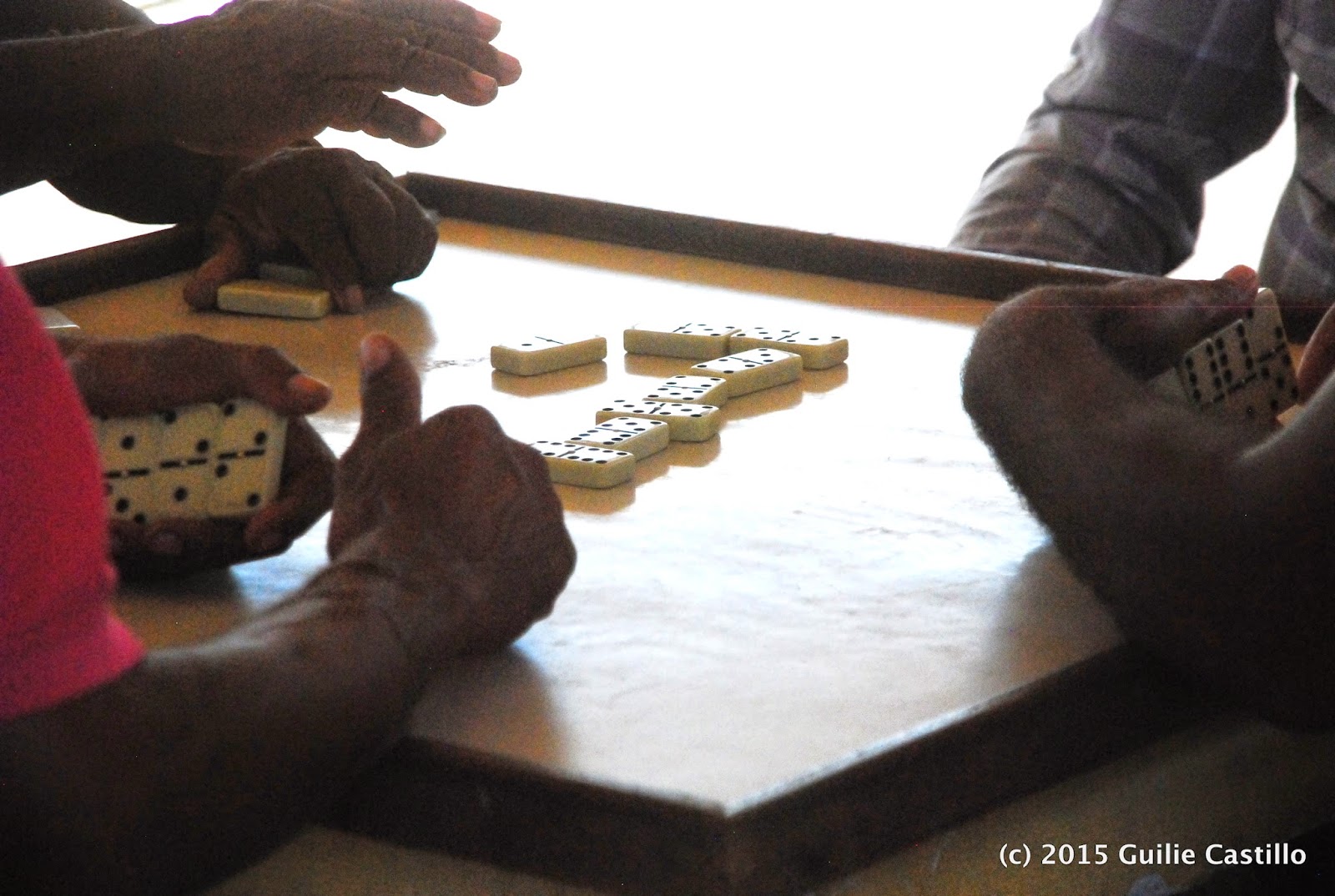
The sharp crack of tiles against wood -- domino tiles, that is -- is a trademark sound of Curaçao streets. At every bus stop and taxi depot, at every snék (when the bachata music isn't too loud--and sometimes even then). Crack! Crack! Crack-CRACK-crack! They follow one another at impossible speed, as if the game is about who slaps them down faster.

And, in a way, I suppose it is.

One of these taxi drivers at the Otrobanda depot gave me
a curt nod as I held up my camera in a non-verbal question.
I snapped away for a good three minutes, but none of them ever looked
my way again.

Sunday, April 26, 2015

Viña! (but not Del Mar) -- Quirks of Language in #Curaçao (#AtoZChallenge 2015)


viña
[VEE-njah]
Literally: vine

Yep. As in the vine that gives vineyards their name. In context, however, it does not mean vine -- it means wine.

Unda Punda -- Quirks of Language in #Curaçao (#AtoZChallenge 2015)

I'm running behind, I know... It's been a hectic month. Besides the A-to-Z, my publisher and I are busy wrapping up THE MIRACLE OF SMALL THINGS for the NYC launch in September -- final edits and tweaks, illustrations (my idea, not so great in retrospect), planning, drumming up support from official sources... Anyway, more on all that later. The point is I apologize for the lack of consistency in these posts. And my unending gratitude to all you who keep coming back in spite of it :)

"Hey, Cor. Unda Punda?"
"Right here, swa!"

Thursday, April 23, 2015

Truk'i Pan -- Quirks of Language in #Curaçao (#AtoZChallenge 2015)

It's actually

truk di pan
[TROOK - dee - PAHN]

but -- go on, say that fast five times. Uh-huh, that K and D don't really jibe, do they?

So, at the speed of speech (especially Papiamentu speech--speed, I mean), it becomes

truk'i pan
[TROOK-ee-PAHN]

Ahhh... So much easier on the tongue :D

This is a quirk of language and custom, but let's start with the language part. Truk is, of course, truck. And pan is the Spanish word for bread. Thus: bread truck -- but the last thing you'll find on one is bread.

Swa -- #Curaçao Expressions on the #AtoZChallenge 2015

swa
[swAH]
(just like the swa in swap or swatch or swan)
Literally: brother-in-law (from the Dutch zwager)
In context: man, bro

Swa is to Papiamentu what man (or bro) is to English.

Watch out for that lamppost, swa.


Wednesday, April 22, 2015

Redu! -- Quirks of Language in #Curaçao (#AtoZChallenge 2015)

Redu
[RED-doo]
Literally: gossip (n.)
(the verb is, officially at least, redashi)
Origin: I think it comes from the Spanish enredo, though the Dutch (roddel) is also close. 

Tuesday, April 21, 2015

(No More) Queen's Day -- Quirks of #Curacao in the #AtoZChallenge 2015

Okay, so this isn't really language-related, and it's not exclusive to Curaçao. But, this island being part of the Dutch kingdom, I think it qualifies as a quirk I can expound on for my Q post. (And, also, there are no Q words in Papiamentu.)

On April 30, 2013, Queen Beatrix of the Netherlands abdicated in favor of her son, Willem Alexander, thereby giving the Dutch kingdom its first king in over a century -- and putting an end to one hundred and twenty-plus years of celebrating Queen's Day.

Saturday, April 18, 2015

Otrobanda & Punda -- Quirks of #Curaçao (#AtoZChallenge 2015)

Seeing as I missed yesterday's O post, you're entitled to a two-for-one today. And Curaçao has a unique feature for that.

Downtown Willemstad, the capital (and only) city of Curaçao, is divided--quite literally, and quite conveniently for this post--in two by the Sint Annabaai (Bay of Saint Anna). It's more of a channel than a bay--part of the natural harbor that made Curaçao so valuable to Spanish and Portuguese and Dutch merchant ships (or pirates, depending on which side you're on) back in the days when transatlantic voyaging was a novelty.


Related Posts Plugin for WordPress, Blogger...